The Human Context Layer
Why the most critical part of your codebase lives in people, not files.

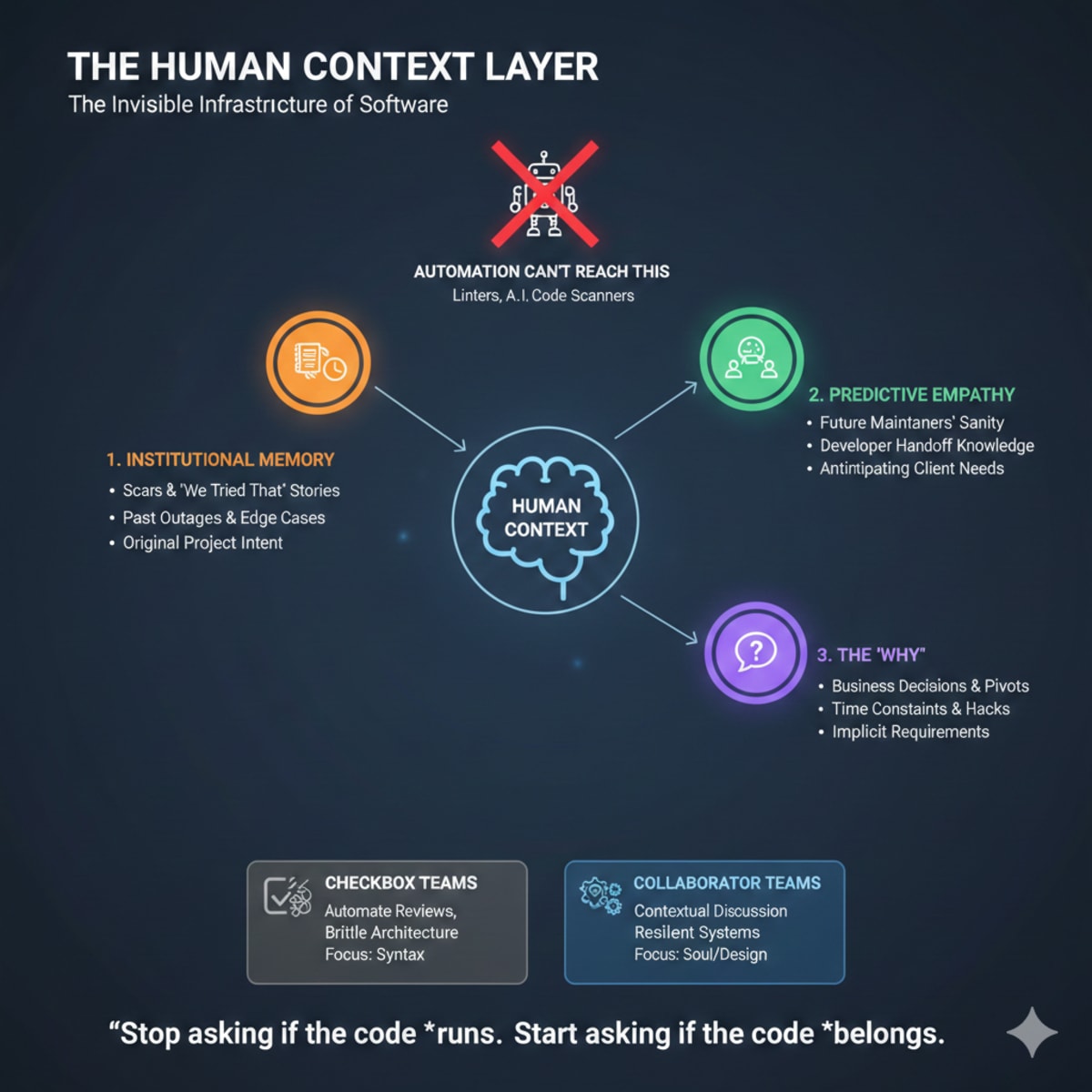
There's a layer of every software project that doesn't exist in the repo. It's not in the Jira tickets. It's not in the README. It's definitely not in the Confluence page that hasn't been updated since 2022.
I call it the Human Context Layer.
It's the collection of scars, "we tried that once" stories, and tribal knowledge that dictates why the code looks the way it does. It's the reason a junior dev can read a codebase and understand what it does, but only someone who was there can tell you why it does it that way.
And when teams rush to automate code reviews, architecture decisions, and development workflows, this is the first thing that breaks.
What Lives in the Human Context Layer?
The Load-Bearing Hacks
That weird if statement on line 402? It looks like tech debt. Any linter will flag it. An AI assistant will confidently suggest removing it and refactoring the logic into something cleaner.
Don't touch it.
That line is the only thing preventing a specific legacy client's API integration from crashing the entire production cluster. There's no comment explaining it because the person who wrote it at 2 AM during an incident assumed they'd come back and "do it properly." They never did. They might not even be at the company anymore.
But someone on the team remembers. Someone always remembers. And in a code review, that someone says: "Don't touch that. Here's why."
No AI has access to that story. No amount of context window is going to surface it.
The Ghost of Requirements Past
Code doesn't just reflect what the product is. It reflects what the product almost was three weeks ago.
Every codebase carries the DNA of abandoned features, last-minute pivots, and compromises made under deadline pressure. Variable names that don't quite match the current domain model. An abstraction layer that seems over-engineered until you realize it was built for a feature that got killed two sprints ago — and might come back next quarter.
A human reviewer sees inconsistent naming and asks: "Are we still planning to support multi-tenancy? Because this code says yes and the product roadmap says no." That's not a linting issue. That's strategic awareness.
An AI sees inconsistent naming and suggests renaming everything to match a convention. Clean diff. Merged. And now the codebase has lost the last trace of a decision that someone will need to understand six months from now.
The Landmine Map
A teammate looks at your "simple" refactor of the payment service and says: "Don't. We tried consolidating those handlers last year and it broke an undocumented integration with the billing team's service. I sat through that incident retro. It took three days to fix."
That's not in the docs. It's not in the commit history — at least not in any way that's easy to find. It exists because a human experienced it, internalized it, and carried it forward.
AI sees clean optimization opportunity. The human sees a landmine.
This is the kind of knowledge that prevents outages, not the kind that passes a test suite.
The Social Architecture
Code is written by people, reviewed by people, maintained by people. Good teams account for that.
"This module is going to be handed off to the new team in Cairo next month. Let's keep the abstractions straightforward and add more inline documentation than we normally would."
"I know a factory pattern is technically correct here, but the two junior devs who'll maintain this will spend a week just understanding the indirection. Let's keep it simple."
These aren't technical decisions. They're human decisions made in a technical context. And they're invisible to any tool that can only see the code.
Why Automation Can't Reach It
Automation thrives on explicit data. Structured inputs, clear rules, documented patterns. And for that category of work, it's excellent — use it, lean into it, let it handle the mechanical stuff.
But the most important parts of software engineering are often implicit.
You can't prompt an AI with the nuance of a hallway conversation where the tech lead mentioned they're "not confident in the billing API's idempotency." You can't encode the specific energy of a client meeting where the CEO said "we love it" but the CTO's body language said "we're switching vendors in six months." You can't feed a model the gut feeling that comes from having shipped and broken and fixed the same kind of system three times before.
That context lives in the people who were in the room. When you treat code review as "check for errors," you're automating the easiest 20% of the job and ignoring the 80% that actually requires a senior engineer.
The Real Cost of Losing Context
Here's what happens when teams over-automate without accounting for the Human Context Layer:
The Confident Refactor. AI suggests a major restructure. It's technically sound. Tests pass. Code coverage is up. Three weeks later, an edge case that only occurs during the European billing cycle on month-end triggers a cascade failure. Nobody on the current team knows why the original code handled that case differently, because the person who wrote it left and the review was automated.
The Clean Slate Trap. A founder vibe-codes an MVP with AI. It works. They hire developers to "scale it." The developers open the codebase, see 30,000 lines with no architecture, no separation of concerns, and naming conventions that suggest the AI was having a different conversation than the founder. There's no human context layer at all — not because it was lost, but because it was never created. Nobody sat with the decisions. Nobody understood the trade-offs. The code exists, but the understanding doesn't.
The Documentation Illusion. Teams generate documentation with AI. It's comprehensive, well-formatted, and technically accurate. Six months later, nobody trusts it because it doesn't reflect the actual state of the system — it reflects the state of the system when the AI last looked at it. The real documentation was always the conversations between engineers, and those stopped happening when everyone assumed the AI had it covered.
What Actually Works
I'm not arguing against AI in development. That would be as pointless as arguing against compilers in the '60s. AI is here, it's useful, and you should be using it.
But you should be using it for the right things.
Let AI handle the syntax. Linting, formatting, boilerplate generation, test scaffolding, pattern suggestions, documentation drafts. This is mechanical work, and machines are better at mechanical work. Free up your humans for human work.
Keep humans on the semantics. Architecture decisions, code review discussions, trade-off analysis, incident retrospectives, knowledge sharing. This is where the Human Context Layer is built and maintained. Automate it and you're saving hours while losing years of accumulated understanding.
Build context deliberately. If your team's knowledge lives only in people's heads, you're one resignation away from a crisis. Create rituals that surface implicit knowledge: architecture decision records, lightweight RFCs, incident write-ups that explain the why alongside the what. Not AI-generated docs — human-written artifacts that capture the reasoning behind decisions.
Review the reviewer. If you're using AI-assisted code review, treat it as a first pass, not a final verdict. The AI catches what a linter catches, maybe a bit more. The human catches what only someone who understands the system, the team, and the business can catch. Those are different jobs.
The Shift
The conversation around AI and software development keeps getting framed as replacement. Will AI replace developers? Will it replace code review? Will it replace architecture?
Wrong question.
The right question is: what are you actually paying senior engineers for?
You're not paying them to type. You're not paying them to remember syntax. You're not paying them to catch missing semicolons.
You're paying them to carry context. To make judgment calls. To look at technically correct code and say "this is the wrong approach entirely." To know where the landmines are buried. To ask "why are we building this?" before "how do we build this?"
That's the Human Context Layer. And it's the one thing that doesn't fit in a context window.
The best teams won't be the ones with the fastest CI/CD pipelines or the most AI-integrated workflows. They'll be the ones who use tools to handle the syntax so they have more time to discuss the why.
Stop asking if the code runs. Start asking if the code belongs.
Written by a developer who's sat through enough incident retros to know that the comment "DO NOT CHANGE THIS" always has a story behind it.

Ahmed essyad
the owner of this space
A nerd? Yeah, the typical kind—nah, not really.
View all articles by Ahmed essyad→Comments
If this resonated
I write essays like this monthly.